

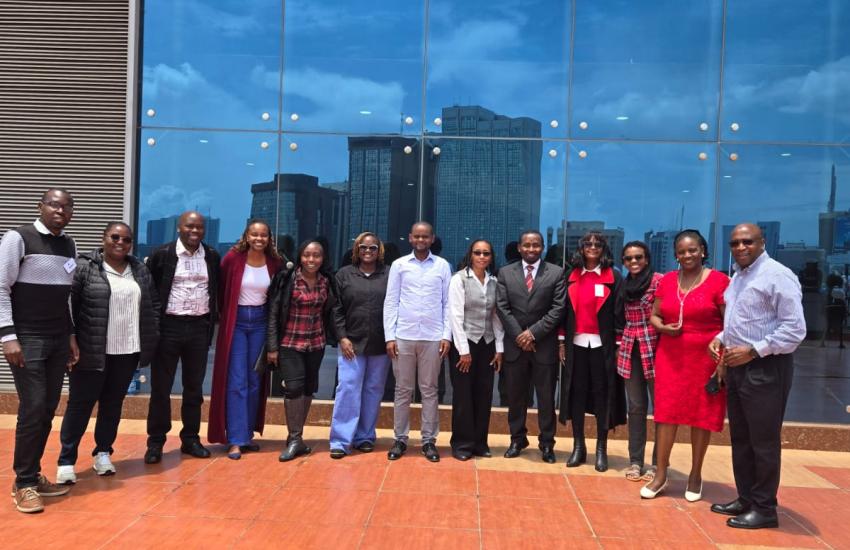
IDS holds 2-day Master of Global Challenges Programme Session
The Institute for Development Studies (IDS), University of Nairobi, hosted a two-day face-to-face session for the Master of Global Challenges Programme. This is a one-year Master’s programme offered by Radboud University in collaboration with the Institute for Development Studies, University of Nairobi. The programme combines academic training with practical experience, equipping professionals with the skills and networks to become effective change agents in international development. It is delivered in a blended model with participants meeting 25% of the time in person, and 75% online.
On the morning of Friday, 27th February 2026, we convened participants for an engaging dialogue on “Actors in International Development and Sustainability.”
This face-to-face session focused on understanding the diverse actors shaping the development sector — from NGOs and private sector initiatives to foundations and impact-driven organisations. Our panel featured:
Beatrice Gichohi from Challenge Fund for Youth Employment
Sarah Mbiira from Macheo Children Organization
Boniface Kinoti from Equity Group Foundation
The discussion explored:
Power dynamics between different actors and how collaboration can drive lasting change
How organisations are responding to the shifting funding landscape in international development
Strategies for ensuring sustainability in programme design and implementation
The importance of mobilising locally available resources
Investment models that guarantee ownership and long-term impact
A key reflection from the dialogue was that sustainability increasingly requires innovation, local ownership, and stronger engagement with the private sector, and prpoper government support through creation of policies that enable good thriving climate. When development interventions integrate investment thinking, accountability, and long-term viability, they are more likely to be sustainable.
Perhaps one of the bold takeaways from the session was this: capitalism, when responsibly regulated and aligned with social impact, can be a powerful driver of sustainable development. A private sector–led model, supported by enabling state policies, can create incentives for efficiency, continuity, and measurable results. Governments, who are the actors who have the greatest agency in development, play a critical role in creating policy environments that spur responsible enterprise and inclusive growth.
The Master of Global Challenges Program remains committed to nurturing reflective practitioners who understand the complexities of development and are prepared to engage diverse actors to create transformative change.
"We don’t inherit the Earth from our ancestors, we borrow it from our children."
Want to express interest for consideration for the next intake? Fill in this link https://docs.google.com/.../1PcAzJBbsep7eQhuZ.../viewform...
#MasterOfGlobalChallenges #InternationalDevelopment #Sustainability #PrivateSectorDevelopment
#IDS #RadboudUniversity #UniversityOfNairobi #ImpactLeadership